The Battery Is Easy. Operating It Isn't: Why BESS Optimisation Decides Value
Storage capacity is no longer the bottleneck in the energy transition. The bottleneck is BESS optimisation: how intelligently each asset is operated once it is live.
Storage capacity is no longer the bottleneck in the energy transition. The bottleneck is BESS optimisation: how intelligently each asset is operated once it is live.
Batteries are being built at a pace few predicted five years ago. The IEA calls battery storage the fastest-growing power technology in the world, with 108 GW added in 2025, up 40% on the year before. Grid-scale BESS, hybrid solar-plus-storage sites, distributed prosumer packs, flexible industrial loads: the hardware problem is, functionally, solved.
The operating problem is not.
The electricity grid was designed around a small number of large, predictable, centrally dispatched power plants. Distributed storage inverts every one of those assumptions. Operators now manage thousands of small, fast-responding assets that charge, discharge, or sit idle on price signals, grid conditions, and weather.
Some assets change state several times within a single hour. That does more than add complexity. It redefines what operating an asset means.
A battery is not valuable for what it produces. It is valuable for when it acts. And "when" is now decided across several markets at once: day-ahead, intraday, balancing, and increasingly flexibility markets run by the DSO itself.
This is the part that separates operators who store energy from operators who run a business. One asset can earn across several market layers in the same day. That only works when the software behind it can see every layer at once and sequence commitments without conflict.
Miss that coordination and the asset works against itself. Picture a balancing bid that can no longer be met, because an earlier intraday trade drained the state of charge. The economics of storage are won or lost in that scheduling logic, not in the cell chemistry.
Volue Trading Suite (smartPulse) couples asset optimisation with automated intraday execution, so a single capacity is allocated across markets in one view. For traders and owners who want end-to-end automation across wholesale and ancillary services, the Volue Trading Suite manages the full workflow from forecast to bid to dispatch.
Timing is tightening across Europe. The EU-wide day-ahead market moved to 15-minute products on 1 October 2025, replacing 24 hourly periods with 96 quarter-hour intervals. More granularity means more price signals, and it leaves far less room for error.
Saturation adds a second pressure. As batteries crowd the same ancillary markets, the value thins quickly. In Texas, the IEA reports the total cost of ancillary services per MWh fell 74% in 2024. The revenue does not vanish. It moves toward whoever can follow it fastest.
BESS operators are not the only ones feeling this. Distribution system operators watch flexible loads and distributed generation multiply faster than physical grid reinforcement can match.
The historical instinct was to solve congestion with concrete and copper. The faster, cheaper answer is to activate the flexibility already sitting on the network. The IEA notes batteries help defer or reduce network upgrades by responding in real time.
That means coordinating batteries, industrial loads, and renewables to relieve constraints as they form. Volue Grid Optimizer lets DSOs forecast congestion early and shift load before it reaches critical levels. It asks the DSO and the asset operator to share one picture, even from opposite sides of the meter. Volue Distribution supports that shift across the full grid lifecycle.
The operators pulling ahead share a pattern. They treat optimisation as a continuous, cross-market function, not a once-a-day planning exercise. They re-evaluate a battery's position as new price and grid signals arrive, well ahead of gate closure.
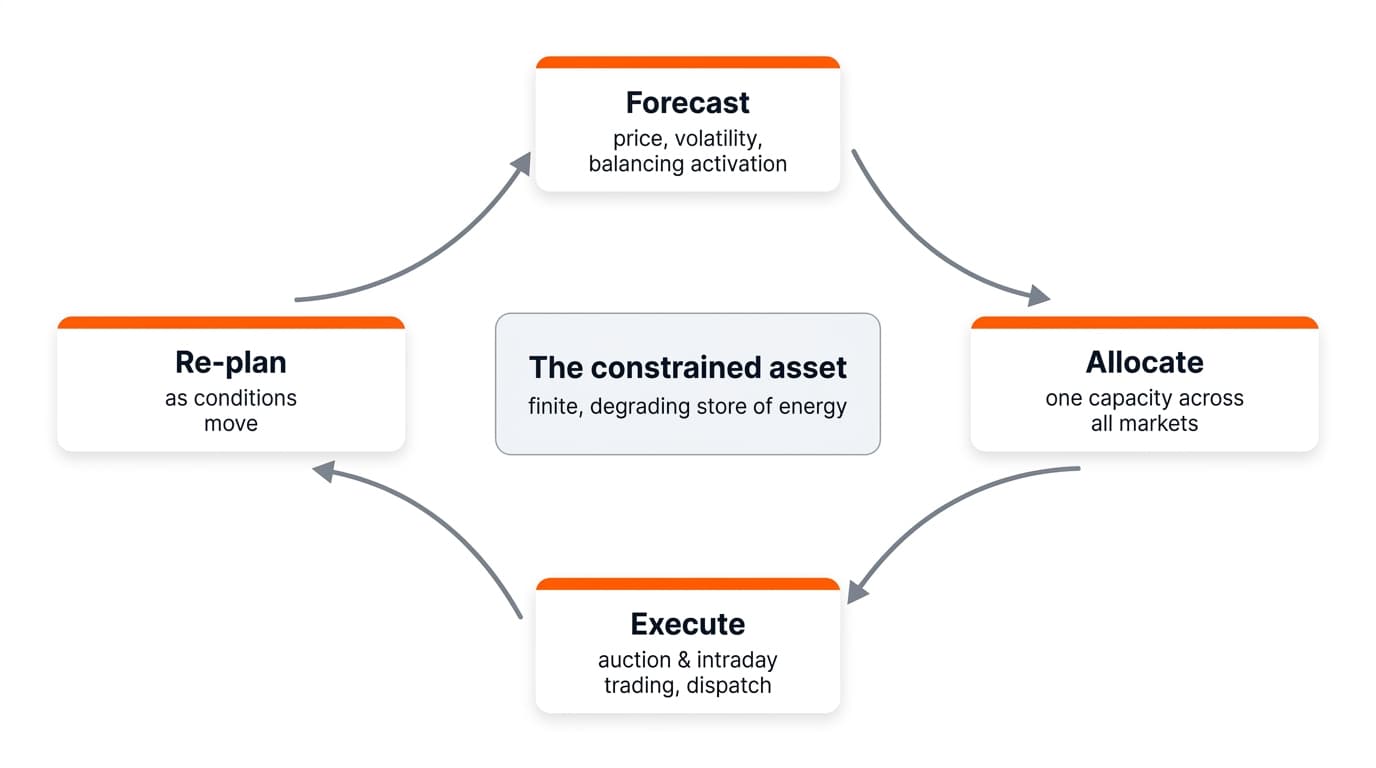
They also do this across a portfolio: a hybrid site, a DSO's flexible load pool. They add new asset types without a bespoke integration for each one.
That is the real shift happening in distributed energy right now. The question has moved from "how much storage can we build" to "how intelligently can we run what we have already built". Organisations that treat optimisation as core infrastructure, rather than an afterthought bolted on after commissioning, will capture the value this next wave of storage can generate.
The batteries are ready. The question is whether the software running them is ready too.
See the full operating framework, and the questions every owner, trader, and DSO should be asking, in the whitepaper From Asset to Algorithm.